

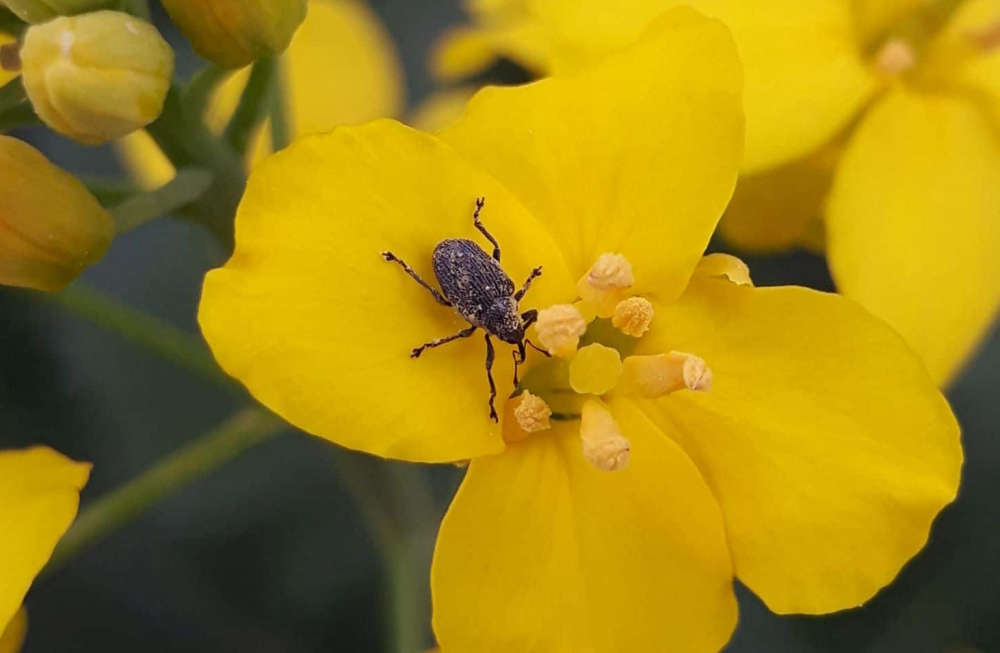
CENTRAL ALBERTA -- Canola producers in Central Alberta are being advised of increasing populations of cabbage seedpod weevils.
These tiny invasive beetles primarily target members of the mustard family, especially canola. Adult weevils feed on flower buds, while larvae hatch inside developing pods and consume the seeds, severely reducing crop yields and degrading pod quality. Recent data released by Alberta Canola indicate higher numbers of overwintering weevils across a larger area than growers have historically experienced, with populations now being found north of Red Deer.
"Begin scouting flixweed patches, volunteer canola, and other canola-related weeds for early signs of weevil activity. CSPW are highly attracted to the colour yellow and often congregate in the earliest flowering areas of a field," reads a statement from Alberta Canola. "While these field edges and early-flowering patches are good places to locate weevils, treatment decisions should be based on field-wide sampling."
The non-profit advises growers to sweep for the invasive insects from the early bud stage through 10 to 20 per cent flowering, particularly in early-seeded fields that attract the first migrating adults. A practical sampling approach is to collect sweep-net samples in four locations throughout the field and average the results. Once hatched, each larva can consume approximately 5–8 seeds before completing development.
It's noted that timing is critical when considering insecticide application. Spraying too early can reduce effectiveness because pods are not yet large enough to support egg laying and because weevils may still be migrating into the field, especially in very early flowering crops. No economic damage occurs until pods reach approximately 1 to 2 cm in length.
Applying insecticide before the majority of weevils have arrived may result in reduced control and the need for additional intervention.
 Seasons Ponoka marks International Day of Older Persons
 New mobile welding lab launched for indigenous students
 Charges laid following shooting in Maskwacis on Sept. 22
 Ponoka to host Halloween drive-in movie on Oct. 30
 Ponoka RCMP Report, Sept 1 - Sept 30